
Since starting my own publishing company in 2007, I have always printed my books with Amazon KDP, or Kindle Direct Publishing. Their fairly simple, almost intuitive management has been wonderful to work with. The photo-heavy format of most of my books made it difficult to create ebooks from them, which is obviously KDP’s forte, but the printing side served my purposes well for more than two dozen books.
And then one day it didn’t. I was close to the end of formatting a book last winter and decided to check something specific about margins, and I discovered to my utmost dismay that the layout size I had chosen for this book was not an option for KDP!
Taking a deep seat and drawing on my past experiences in publishing, I decided my best option was IngramSpark, a service of Lightning Source, which had always delivered quality printing and distribution services when I was producing books more traditionally, and not using the print-on-demand format. Print runs of thousands of copies was outside my budget when I started Northern Light Media, however, and the print-on-demand model proved to be an excellent choice, but I wanted to notch up the quality of my books, and I wanted different distribution options. To be sure, IngramSpark is a much more complicated program to work with, but I am optimistic about my ability to understand the particular hoops I need to jump through with them. I am certain that in the end I’ll be much happier with their approach to publishing than with Amazon KDP.
By the same token, I have used the Apple program Pages to lay out and format all of my books since the beginning. It has done everything I wanted it to, and by creating my own templates, with my own pre-formatted settings, I’ve been able to produce books which checked all of the boxes I felt were important. But times change, I learn more and more as I go along, and I was no longer satisfied with the results I was getting with the Pages program. So I looked into, and have been learning, the page layout and design software Affinity Publisher. Once again my past experience as a publisher has informed my decision, for I found similarities between Affinity and the QuarkXpress program I first learned layout and design with back in the 1980s, and understanding the basic principles of layout and design, fonts and styles has made the whole learning process easier.
So far I’m pretty pleased with Affinity, although I still have a long way to go before entrusting my newfound skills with it to one of my books. If all goes well, however, I may be switching all of my books over to this program, and revising several of them in the process.
After 17 years as a publisher it feels strange to be making these transitions to a new layout program and a new printing and distribution company, but at the same time it feels like leaving high school and going off to college, taking the skills I’ve learned and applying them to further learning, which will result in even more skills and a greater confidence in my abilities and achievements.
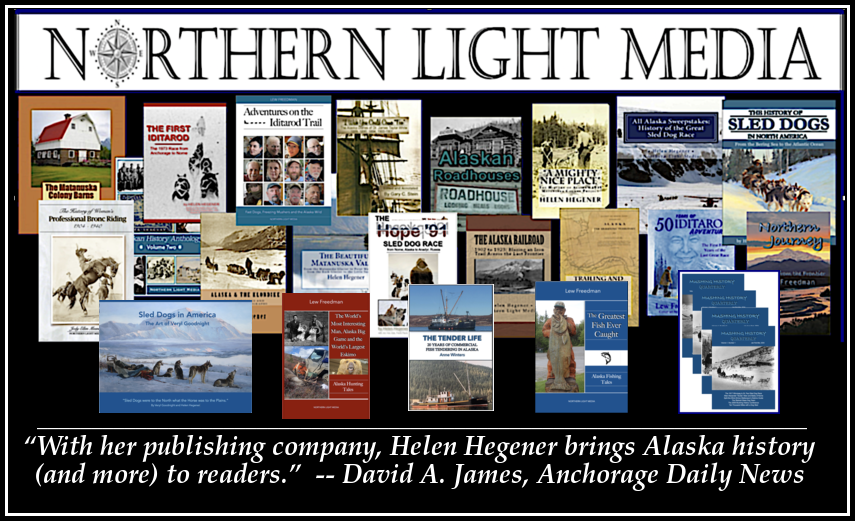
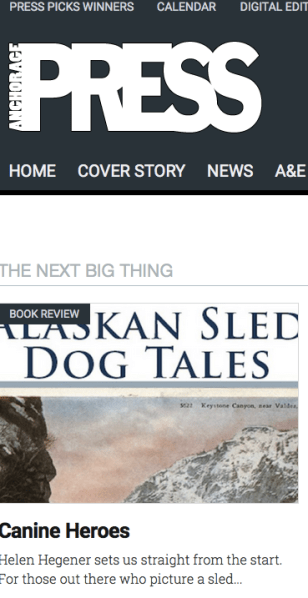 Authors always love to see book reviews, and this author is no exception. With a dozen titles currently in print I’ve seen quite a few reviews, but I still smile when one crosses my path, as
  Yeah, that nicely captures what I set out to do with this book! David Fox shares some examples from my book, and then leaves me grinning with his parting shot: “These trustworthy creatures could be relied upon to do the heavy work, while remaining—as Hegener eloquently reminds us—our most treasured friends.”
 Alaskan Author Helen Hegener